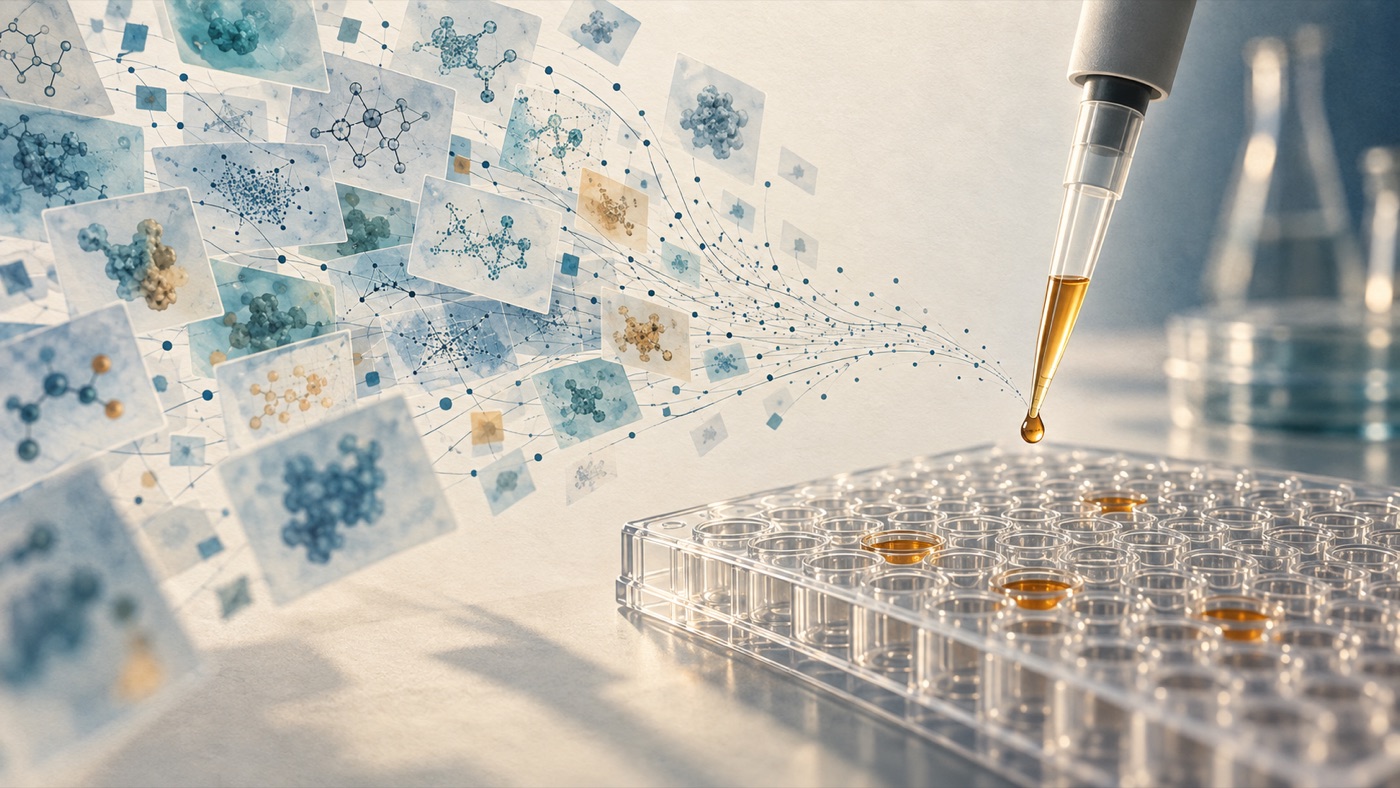
Agentic AI is changing how biotech organizations reason about their data. Over the past year, one consequence has become difficult to ignore. Generating a credible hypothesis is no longer the rate-limiting step in discovery.
The cost of a hypothesis has collapsed
Until recently, a cross-dataset question inside a biotech company required a queue. A computational scientist had to locate the data, clean it, integrate it with other sources, and write the analysis. That process took days and often weeks.
An agentic system can now produce a reasonable first pass in an afternoon. It can draw on internal omics data, public genetics, and the literature. It then returns ranked hypotheses with the reasoning attached.
Two published studies show what this looks like in practice. Both used Google’s AI co-scientist, a multi-agent system built on Gemini 2.01. Researchers at Imperial College London asked it how a class of mobile genetic elements spreads across bacterial species. Within two days, its leading hypothesis matched a mechanism the team had established through years of unpublished experimental work23. At Stanford, Gary Peltz’s group used the same system to nominate drugs for repurposing in liver fibrosis. The system proposed three candidates, and Peltz selected two of his own. Two of the AI-nominated drugs reduced fibrosis in human liver organoids. Neither of his selections did345.
Analysis is no longer a specialist privilege
The more important change is who gets to ask the question. Bench scientists, program leads, and new hires can now interrogate data directly. The people who best understand an assay’s limitations can test their own intuitions without waiting for analyst time.
I believe this raises the collective intelligence of an organization. More people with real context are forming views grounded in evidence. The pool of hypotheses becomes both larger and stronger.
This shift carries a risk. Inexpensive ideas also produce a great deal of confident, plausible noise. System design matters. In the Imperial study, several general-purpose language models received the same question. None produced the hypotheses that proved experimentally correct3. Grounding in real data, structured critique, and rigorous benchmarking separate genuine insight from fluent guessing.
The bottleneck has not moved
Biology must still be tested in cells, in animals, and ultimately in patients. No model can shorten the time an animal study takes to run.
The Imperial researchers acknowledged this directly. They recognized that a novel AI-generated hypothesis could take years to validate. They therefore posed a question they had already answered in the laboratory6.
Clinical development is even less forgiving. An industry analysis covering 2011 to 2020 placed the likelihood of approval from Phase I at 7.9%7. A more recent Citeline estimate puts the figure at 6.7%8. A larger supply of hypotheses will not change these numbers. Validated hypotheses will.
What separates the companies that succeed
Safe adoption of AI. This requires clear data access policies, audit trails, formal evaluation of every agent workflow, and a named human accountable for each decision. Speed without trust only produces faster errors.
A shorter path from hypothesis to test. The metric worth tracking is the number of days between an idea and its first experimental readout. Higher-throughput assays, laboratory automation, and tighter coordination between computational and experimental teams all reduce it. When ideas are nearly free, experimental throughput determines who leads.
Proprietary data generation. Every organization’s agents can read the same publications and the same public atlases. Foundation models are becoming commodities as well. The durable advantage is data that no one else holds. Each experiment should sharpen the next round of hypotheses in a way competitors cannot replicate.
Conclusion
AI has democratized the reasoning stage of discovery. It has not democratized the validation stage. The organizations that pull ahead will combine inexpensive hypotheses with fast, trusted experimentation. They will then return every result to a dataset that cannot be copied.
References
-
Gottweis J, Weng WH, Daryin A, Tu T, et al. Towards an AI co-scientist. arXiv:2502.18864 (2025). https://arxiv.org/abs/2502.18864 ↩
-
Penadés JR, Gottweis J, He L, Patkowski JB, et al. AI mirrors experimental science to uncover a mechanism of gene transfer crucial to bacterial evolution. Cell 188(23):6654-6665.e2 (2025). https://doi.org/10.1016/j.cell.2025.08.018 ↩
-
Dolgin E. Google’s AI Co-Scientist Scores Two Wins in Biology. IEEE Spectrum, 25 September 2025. https://spectrum.ieee.org/ai-co-scientist ↩ ↩2 ↩3
-
Guan Y, Cui L, Inchai J, et al. AI-Assisted Drug Re-Purposing for Human Liver Fibrosis. Advanced Science 12(44):e08751 (2025). https://doi.org/10.1002/advs.202508751 ↩
-
Google DeepMind. Co-Scientist: Finding new treatments for liver fibrosis. https://deepmind.google/blog/uncovering-repurposed-medicines-to-fight-liver-fibrosis/ ↩
-
Imperial College London. Google’s AI co-scientist could enhance research, say Imperial researchers. 19 February 2025. https://www.imperial.ac.uk/news/261293/googles-ai-co-scientist-could-enhance-research/ ↩
-
BIO, Informa Pharma Intelligence, QLS Advisors. Clinical Development Success Rates and Contributing Factors 2011-2020. February 2021. https://www.bio.org/clinical-development-success-rates-and-contributing-factors-2011-2020 ↩
-
pharmaphorum. Clinical development rates are falling, but it’s not all bad news. 18 July 2024. https://pharmaphorum.com/rd/clinical-development-rates-are-falling-its-not-all-bad-news ↩